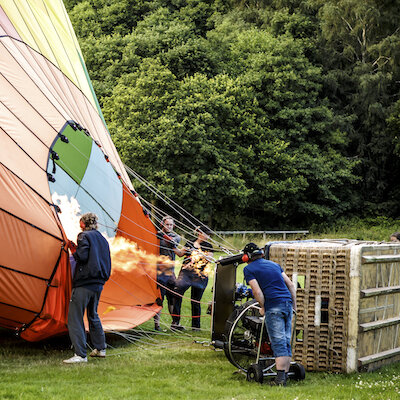
Why are hot air balloons so big?
A cubic foot of air weighs about 28 grams, but when heated to around 38°C, it weighs about 7 grams less. So a cubic foot of warm air can lift about 7 grams – hardly anything at all. To lift 450 kg, you need about 65 000 cubic feet of hot air. And that’s why balloons are so big.
How do you steer a hot air balloon?
There is nothing like flying an airplane. No rudders, no controls, no autopilot. But it’s not completely random either. It’s mainly about controlling altitude and temperature, as well as planning the route so that there are suitable places to land within reach.
To rise , the pilot heats the air in the balloon, making it lighter (because hot air is less dense, remember?). To descend, hot air is released, causing the balloon to cool down, become heavier – and sink.
Sometimes, for example, if the wind dies down, the pilot can use the burners to climb to a higher altitude where the wind is stronger. At different altitudes, the wind often blows in different directions and with different strength.

How safe are hot air balloons?
Hot air balloons are actually among the safest means of transportation.
They are built to last: the fabrics are fire-resistant, the burners are advanced and the baskets are designed to protect passengers – even in the rare event of a hard landing. Pilots undergo extensive training over several years before receiving their license, so they know exactly how to handle balloons and all safety aspects.
The risk of something going wrong is less than you think. A common question is: “What happens if a balloon falls?” – but it’s not that likely at all. The balloon envelope itself acts as a parachute, so a hot air balloon will never fall quickly – even if you want it to.
In addition, a safety briefing is always held before each flight so that all passengers know what to expect and how to prepare for landing, for example.

Can anyone fly a hot air balloon?
Of course you can’t. You can’t just jump into a balloon and expect to float among the clouds. Becoming a certified pilot requires a huge commitment. To the untrained eye, it may seem like something quite simple – but it’s really not.
To even begin to think about flying a hot air balloon, one must undergo extensive training covering everything from weather patterns, burner systems, meteorology to aviation legislation. Pilots undergo regular and thorough medical examinations, which determine the validity of their license, which is issued by the Swedish Transport Agency. In addition, a certain minimum number of logged flight hours is required before you can get your license. There are no shortcuts here.
But the good news? Once you’re trained and licensed, it’s entirely possible for the average person to fly a hot air balloon – if you’re ready for a little adventure and a lot of responsibility. When you are ready, the sky is waiting for you!
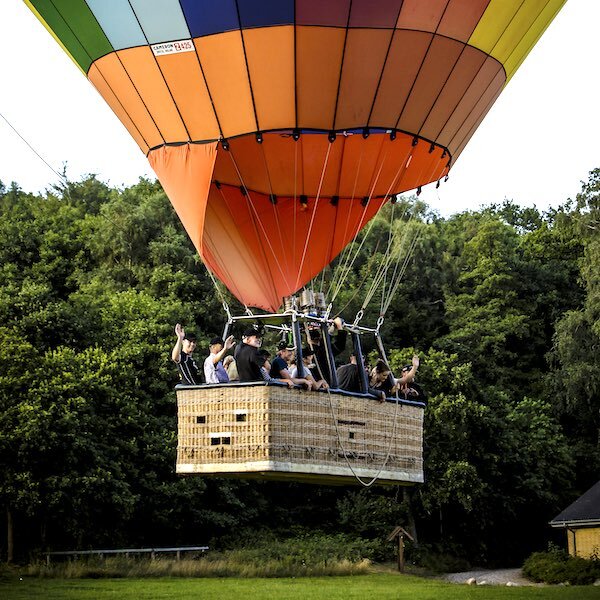
What happens if a hot air balloon bursts?
Fortunately, there is no such thing as a balloon ‘bursting’. Balloons are made from a strong, durable fabric that is tough enough to withstand both heat and stress during flight. The fabric, Nomex, is also used in firefighting equipment thanks to its refractory properties.
Balloons are not like the small balloons we use for birthday parties, where the material is stretched due to high internal pressure.
Even if there is a tear in the balloon envelope – and even if it is visibly large – the balloon can usually still fly safely. An important role is played here by vertical and horizontal load straps that divide the envelope into panels. These extremely strong straps prevent tears from spreading to other parts of the balloon
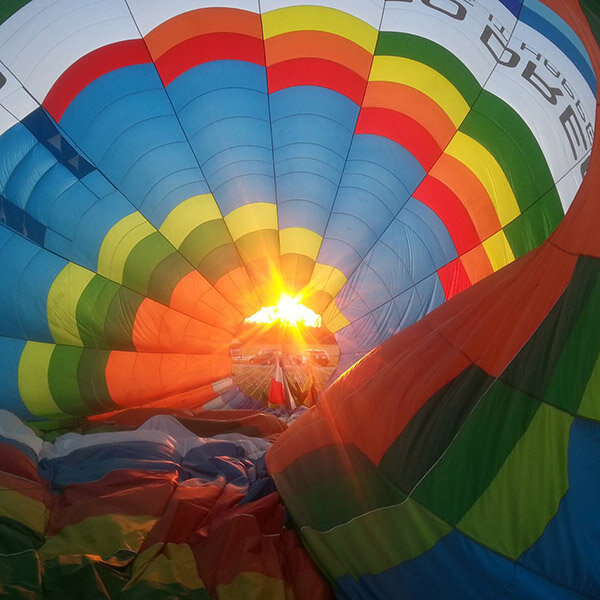
What happens if a hot air balloon runs out of gas?
Balloons run on liquid propane, which is easy to monitor and store in sufficient quantities to ensure you don’t run out unexpectedly. But most importantly, pilots and ground teams always make sure that there is a significant surplus of gas, so that we still have plenty of fuel left when we land.
But theoretically, if a balloon were to run out of fuel, it has an amazing ability called controlled descent.
Another safety measure pilots take is to carefully plan landing sites before the flight, taking into account current weather conditions and specialized forecasts. This way, we ensure that there are plenty of possible landing surfaces throughout the flight. This is also why a pilot would never choose to fly over a 30-kilometer forest or huge wetlands.